
A Threshold below the Noise
Begin with an almost empty view
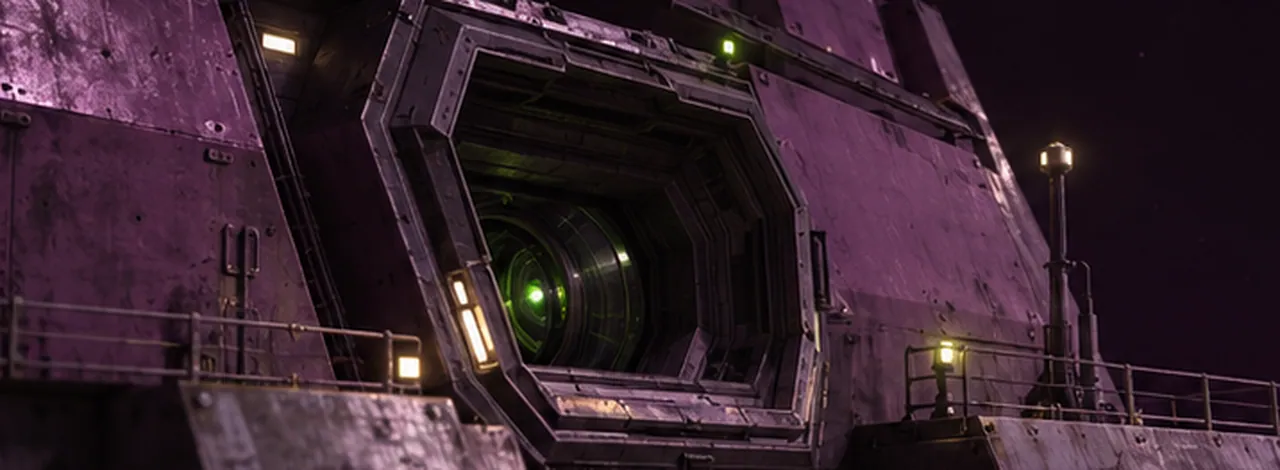
The relay holds a narrow aperture on its dark side above the fictional colony. A small light enters it during a quiet watch. In the first illustration the whole inside edge already glowed around a bright center. The next arrival looked like another part of that light. Someone at the receiver could hear the accompanying cue and still be unsure where in the image the useful change had appeared.
Give the arrival a darker place to be seen
The current view has a shadowed portion of the aperture beside the old rim. When a faint signal reaches the receiver, a thin bright shape appears above the rim from its far side. The steadily lit portion keeps a quieter color. This difference makes it possible to read where the new movement began without watching the entire aperture at once. The edge beside it also supplies a location you can find after the light is gone.
Retain a line through an apparent change in the housing
The close camera can make part of the case appear to turn when only a reflection moves. We keep a seam near the fixed base where the metal still shows a little pale light. Use that seam to compare the moving patch with the physical location of the aperture. Once the chamber has rotated, the bright shape can be observed again in relation to the earlier seam, even if the whole housing does not retain its original position in the view.
Place the next watch near the first one
In The Last Colony Call the keeper can return to a slightly wider position before trying a new angle. A small part of the colony is visible across the instrument there. The light was originally drawn near the upper half of the receiver, and there is a similar patch beside its lower edge. A clear second arrival should give much the same direction using the wider view, so both pictures can be checked.
Keep a faint patch after lowering the receiver's emphasis
The control in the prototype changes how prominently faint light events appear on the screen. At the stronger setting, a faint edge on the opposite side of the aperture becomes more visible. The useful arrival retains a tighter shape. Lower the setting and check the direction of the shape before it disappears. Its placement matters even when the brightest line around the housing happens to be somewhere else.
Follow an echo from a nearby surface
An Echo from the Shell compares a second light that slides along one of the panels. The receiver view offers enough of the panel to show why the light seems to come back. An earlier frame showed a similar brightening on the other side of the opening. Putting both observations in the record gives the player two independent ways to check the signal. One uses the shape itself and the other uses how it changes with angle.
Test sound as another place to start
A small tone can tell someone to look over from the wider picture. When the sound is removed, the first bright shape should still be able to attract attention from the edge of the view. We reduce the strength of other small lights near that corner and keep their movement slow. This leaves a time when the faint signal is among the few things that change.
Take the threshold to the next record
Deep Space Log starts with this initial observation beside the first relay. The next prototype may move that signal closer to the edge of the housing and give the player less of the original aperture to compare. Keeping one fixed feature in a different place should still help separate the light event from the gradual movement around it. The note records which original edges remained visible before trying that change.